Saturday, February 27, 2016

February 27, the anniversary of the Caracazo

On February 27, 1989 hundreds of thousands , perhaps millions of Venezuela's poor rose up against an International Monetary Fund imposed austerity program that included a devaluation of the currency and an increase in the cost of gasoline.

It's still not known how many hundreds or thousands of people were killed on February 27 and 28. The repression inspired young military officers, led by  Colonel Hugo Chavez to attempt to overthrow the blood soaked Fourth Republic regime, which was based on an agreement between the two leading parties, one supposedly socialist, (ADECO) and one supposedly liberal, Christian Democratic.  Both parties were corrupt. After the military - civil uprising was crushed Hugo Chavez was allowed to go on television to urge his hold out comrades to lay down their arms "for now." His television speech won the hearts and minds of millions, and eventually he was released from prison. He ran for President and destroyed the ADECO - COPEI  regime. 

Chavez governed from 1998 until his death in 2013. His governance was characterized by populist programs that alleviated poverty and gave hope to Venezuela'spoor. Illiteracy was done away with. A widespread (though not universal) system of primary medical care and free advanced care again, not universal. Chavez institured foreign policy initiatives that challenged the United States in the international arena.


Hugo Chavez pulling Uncle Sam's beard in front of the world.


  The old regime parties imploded and fragmented. For ten years Venezuela enjoyed high prices for its main product - petroleum.  Chavez instituted a foreign currency exchange system that was designed to permit cheap government subsidized food to be widely available.  The system was wide open, though for abuse and corruption.  Venezuela never prepared for the eventual collapse of petroleum prices, ignoring western and especially US efforts to end depending on  imposed petroleum products. Truly these efforts in part, constituted an economic war on oil exporting countries,  especially Venezuela,  Russia and Iran.

Now Venezuela's people are not getting enough to eat, are lacking in medicines and stand on hours long food lines. President Maduro has instituted gasoline price increases , devaluation and a computerized system to try to control food hoarding and smuggling.

Today no one who cares about Venezuela  (like I do) in their right mind would want another Caracazo. 

Dissident socialists, once aligned within the Chavis take movement, are claiming that  up to $450,000,000,000 were stolen from the Venezuelan people and stashed abroad.  They seem to be like the prophet Jeremiah, lamenting the faults or sins of the past. They've been rebuffed by the Ombudsman, the Attorney General,  and the office of morals and ethics. A few days ago they petitioned the National Assembly,  which is now dominated by opponents of the Chavez movement.  They say that if need be they'll turn towards international organizations. 

Jeremiah in tears. 


Saturday, February 20, 2016

Mind boggling events in Venezuela.

I've been avoiding comment about Venezuela and the political events there. Frankly I find things are a bit mind boggling.

Let me recap some major events.

In the background,  but looming large is Venezuela's long dependency on petroleum exports and its dependency on imports for almost everything Venezuelans consume. A few years ago it might have seemed that Venezuelan petroleum would forever be the fat goose laying golden eggs. This mind set would have been a comfortable one. It had to be based on a belief that the United States wasn't serious about ending its dependency on foreign oil. It would have had to overlook American hostility towards Venezuela, Russia and Iran. Of course, fracking, solar and wind power and hybrid cars have other other motivations beyond political hostility towards certain petroleum exporting nations. There is money to be made, and there are legitimate concerns about climate change. In a market system each is at war with all. Consuming nations are in economic war with producers, capital is at war with labor and all other capital.

And so, when oil prices started to collapse, Venezuela was caught short - not much in savings,  weak agricultural and industrial development, and no foreign tourism worth mentioning.

And so, it should be easy to understand Venezuela's current distress - it's serious and getting more serious by the day.

These obvious factors do not tell the whole story by any means. Hugo Chavez, widely revered, had a tendency towards making announcements without preparation or follow up.  For example when he first mentioned forming the United Socialist Party he spoke of a highly select body of selfless and exemplary people who would guide the revolution. Then he announced that all of the parties that had supported him were to merge into the new party, but he had not approached any of them before going on television with the news. Very soon the party became a classic ruling party, and government employees were encouraged to join. When President Chavez's proposed constitutional reforms were voted down ( his only electoral defeat) the changes got fewer votes than the number of members of the ruling party.)

Chavez also announced a program of savings from oil income to hold for hard times and for investment in the country's development. This clearly never happened. In fact the country's enmeshed in debt.

Inside the Chavez movement questions and critics were and are frowned upon at best. In such a situation cliques of money grubbing yes man careerists and crooks can worm their way into positions of authority from which they will find theft opportunities.

Venezuela's multifaceted currency exchange system, designed to help the poor with subsidized food staples, and supposedly also to thwart capital flight seemed to work, at least the cheap food part, for around ten years. It also turns out that it was an excellent theft opportunity.  The dissident Chavista politician, Nicmer Evans,  says that his organization,  Socialist Tide, can demonstrate that  $450,000,000,000 have been embezzled from 1998 to the present. On Wednesday President Maduro acknowledged that Venezuelans have $300,000,000,000 stashed outside the country. Where Evans wants to prosecute and seize these assets, President Maduro announced that he is encouraging them to reinvest the money into Venezuela.

In 2013 the food lines and shortages and high inflation that anyone who follows the situation in Venezuela is familiar with started to appear, while oil prices were still at $100 a barrel.
Why? Venezuelan President Maduro points to an economic war being waged against Venezuela by the United States and its aligned businessman / oppositionists. True. But...

People choose and support political leaders in the belief that these leaders can thwart these enemies. On Wenesday President Maduro gave a five hour televised address where he revealed the plan. I'll get back to this, but I want to share some flashbacks of the past six weeks.

A month after he got his head handed to him by the voters, President Maduro announced a cabinet shake up. Keep in mind that were Venezuela's political system parliamentary Maduro would have resigned as both head of the government and leader of the ruling party. Elections would have been called. Perhaps it's good that this wasn't the case, because the opposition is fragmented,  just as corrupt as anyone else and it doesn't have the confidence of many Venezuelans.  These are oligarchs and their successors who took Venezuela down a path that led to a political revolution, the Hugo Chavez revolution.

President Maduro rehuffled his cabinet. Generals and Colonels in cabinet and sub cabinet posts were told to return to soldiering. This didn't much happen, and now the military is back with more power and responsibility than before. I'll get to that in a while. A sociology professor, also a leftist hardliner by reputation , Luis Salas, was named Economy Vice President and put in charge of a disperate team. A few days ago he resigned, citing family responsibilities. Some pundits say that he was fired. On the day that he left office Venezuela made a payment of  $72 million interest to bond speculators. It is said that Salas argued against paying the speculators while Venezuelans are going hungry. He was replaced by Miguel Perez Abad, a businessman and former lobbyist for small and medium sized businesses.  This news was met with cautious praise in the US media and no doubt high fives among the Wall Street bond trader bros.

Emma Ortega, a relative outsider, a respected farm activist and agronomist was brought into the cabinet. She got right to work, encouraging city dwellers to produce food, even if it were only an herb grown in a vase on a window sill. She was widely ridiculed and was gone in two weeks.

There have been some high profile corruption arrests of government food system managers and supermarket employees. The same kinds of images of seized hoarded staples that have been shown on government television for around two years now were on television once again. The government markets are being handed over to Venezuela's communes.  Many Venezuelans saythat most of the communes exist on paper and that some are enmeshed in nepotism and corruption.

The government will grant preferential dollars to businesses that use them to purchase food, medicines and inputs such as fertilizer. This is nothing new. The difference is that the preferential dollars now cost ten bolivars each, no longer 6.32. With black market dollars fetching over a thousand bolivars it remains to be seen how much food and medicine will make it to the shelves of Venezuela's retail establishments. Past results don't give much to be confident about. Gasoline will remain the cheapest in the world if you figure by the black market dollar, not so cheap for someone whose income is from a wage denominated in bolivars with 96 octane selling for the equivalent of  $2.85 a gallon. 91 octane gasoline is selling at the equivalent of 38 cents a gallon. Watch the 91 octane become unavailable. At the black market dollar rate these prices amount to ridiculously cheap.

A separate corporation, to be owned by the military, is being established by the President to be active in the petroleum and mineral areas. It is possible that this is a step in preparation for a bond default by the national oil company,  PDVSA. Venezuela is rich in Coltan, a rare mineral that's found in one of the remotest part of the country.  It's reportedly being illegally mined and smuggled out of the country. Venezuela has potential also in oil and diamonds.

Fair prices, which the government tries to impose on the markets will be redefined to account for production costs. ( Perhaps the fact that this is a new wrinkle would explain some of the difficulties shoppers have been experiencing.)

The government is issuing debit cards to be used for purchasing food. I don't know the details. Hopefully my friends in Venezuela will be able to fill in the blanks as that program gets implemented.

Meanwhile opposition governor Capriles,  who opposed the violent demonstrations of 2014 that were intended to force President Maduro to resign, is launching a recall petition against President Maduro. Maduro was elected president over Capriles in 2013 by a narrow margin. Some Chavistas believe that the president would be doing a service to the nation by resigning and handing over the post to his vice president. A recall petition has the potential for aggravating the polarized social and political scene.


                  Emma Ortega


Saturday, February 13, 2016

The US is at war with Venezuela

Why do I say this? Well, for one thing  Obama did officially declare Venezuela a "national security threat to the United States.

Obama  "walked it back"
unofficially and as a result of the public relations mistake the Declaration turned out to be. However, the proclamation has not been officially revoked. Venezuela built UNASUR, as opposed to the United States dominated Organization of American States. Venezuela defied sanctions against Iran. It invited Russian forces to visit. It replaced the United States as its main trading partner with China. Venezuelan diplomatic efforts resuscitated the Organization of Petroleum Exporting States.
Venezuela broke relations with Israel. It refused to accept the credentials of a United States Ambassador.

President Obama nominated Larry Palmer to be ambassador in Caracas.

Mr. Palmer answered questions about Venezuela by Sen. Lugar (R) saying that morale was low in the Venezuelan armed forces, and that Colombian reports of FARC bases in Venezuela are credible and should be investigated. 

In response, President Hugo Chavez refused to accept Palmer as U.S. ambassador.

This is an impressive list of Venezuela's "impudent" acts against US world dominance.  It would be naive to assume that these actions would go unpunished. 

              
Venezuela rejected the assignment of Larry Palmer as United States Ambassador.


Venezuela is now going through a series of epidemiological problems with mosquito borne zika, malaria, dengue and chickenguya cases compounding Shortages of medications, medical equipment, high protein foods, and physicians. (There is reason to believe that zika is also a sexually transmitted disease - a serious threat in a country where condoms are difficult to find and priced beyond the means of most people.) The government is loath to use the words "medical (or humanitarian) emergency" fearing that this could be a prelude to a style Haiti "humanitarian intervention."

This 2013 video could have been made yesterday. Haiti after a "humanitarian intervention."

Now That the  United States backed and funded  opposition dominates the country's legislative branch it is pushing for a declaration of a humanitarian crises in Venezuela. 

The United States has a history of waging unconventional warfare Against Civilian Populations.
Socialist Cuba is Mobilized Against insect borne diseases. 


United States Drug Enforcement Agency and Special Forces are based in Colombia, while Hugo Chavez expelled United States Drug Enforcement agents for interference in its internal affairs.


Wednesday, January 27, 2016

Venezuelan Politician Urges International Assistance in Medical Emergency


Of course Nicmer Evans is talking about the fact that Venezuela is suffering shortages of medications (not to mention medical equipment ) that is causing poor health and unnecessary deaths. Evans is leader of a small political party called "Socialist Tide. " This party's history is inside the Chavez movement but it is not presently part of either the Socialist Party coalition nor the opposition "Democratic Roundtable" which won a resounding victory in elections for the country’s Parliament on December 5 and took charge on January 5.
The country's economy is in very bad shape with shortages of staple foods and personal necessities. Inflation over 2015 was over 100%. The International Monetary Fund has forecast that the economy may shrink by 10% this year with a possible rate of inflation of 700%. The country's main export is petroleum. Prices for petroleum shrank from $145 a barrel in 2013 to around $27 a barrel now.
The past month shows. that neither the Government nor the opposition that dominates the parliament are confronting the urgency of the situation in Mr. Evans' opinion.  No doubt that by asking for foreign help with the medical humanitarian crisis he is hoping to focus the attention of the government and the parliament on the urgent conditions that Venezuelans now face.


Saturday, January 23, 2016

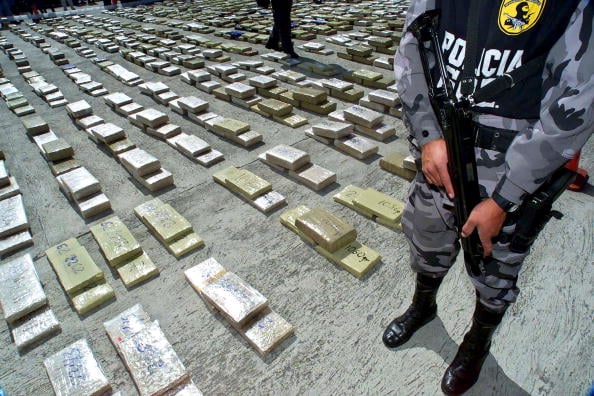
Narco States

Western banks reap big money handling the filthy lucre generated by the International trade in cocaine,  marijuana, and heroin. 

Recently, there has been lots of noise, a couple of arrests, and leaked threats of US prosecutions against Venezuela and prominent Venezuelans. I bring this up (again) not to assert that any particular person who has been or will be accused is innocent (or not). I am concerned that the United States government may very well inflict  broad sanctions  on Venezuela or even invade Venezuela on a drug war pretext. Venezuela is now going through a very difficult time. It owes a great deal of money to the international one percent, much of it coming due soon, and it may be unable to make the payments on time. On top of that an issue of a major multi billion dollar embezzlement is emerging and this may prove out that a substantial part of that debt is illegitimate and ought not be paid. 
It ought to fall to Venezuela and its people to work through these problems. 

Recently Henry Ramos Allup, incorrectly christened a democrat, has risen to a place of  political power  as President of Venezuela’s National Assembly along with a coalition of political parties who oppose the president of the country, Nicolas Maduro. 


My point is that Ramos Allup is interested in pleasing the political officers in the US Embassy in Caracas.  He would be capable of declaring himself Venezuela's president and requesting US military intervention. 
I've added information that I hope exposes the hypocrisy of any US "concern" about real or imagined drug trafficking by Venezuelans.


US Marijuana Legalization Gives International Law The Middle Finger . In fact, even before the marijuana legalization craze began marijuana was the number one cash crop in the United States. 

http://www.drugscience.org/Archive/bcr2/cashcrops.html

At an estimated $35.8 billion marijuana is by far the largest cash crop in the United States when compared to the average production values of other crops from 2003 to 2005. (Production values for other crops were obtained from the Department of Agriculture. [22])
Table 7. Top Cash Crops in the United States (Average Value 2003 – 2005)
Average
Rank
Crop
Production
Value ($1000s)
1
Marijuana
$35,803,591
2
Corn
$23,299,601
3
Soybeans
$17,312,200
4
Hay
$12,236,638
5
Vegetables
$11,080,733
6
Wheat
$7,450,907
7
Cotton
$5,314,870
8
Grapes
$2,876,547
9
Apples
$1,787,532
10
Rice
$1,706,665
11
Oranges
$1,583,009
12
Tobacco
$1,466,633
13
Sugarbeets
$1,158,078
14
Sugarcane
$942,176
15
Sorghum
$840,923
16
Cottonseed
$821,655
17
Peanuts
$819,617
18
Barley
$653,095
19
Peaches
$474,745
20
Beans
$467,236
Based on a comparison


BORDERLAND: DISPATCHES FROM THE U.S.-MEXICO BOUNDARY

Awash In Cash, Drug Cartels Rely On Big Banks To Launder Profits

A woman uses a cash machine at an HSBC bank office in Mexico City. The multi-national bank was heavily penalized several years ago for permitting huge transfers of drug cartel money between Mexico and the U.S.
Enric Marti/AP
The Sinaloa Cartel, headquartered on Mexico's northern Pacific Coast, is constantly exploring new ways to launder its gargantuan profits. The State Departmentreports that Mexican trafficking organizations earn between $19 and $29 billion every year from selling marijuana, cocaine, heroin and methamphetamines on the streets of American cities.
And Sinaloa is reportedly the richest, most powerful of them all, according to the Drug Enforcement Administration. The capture last month of the Mexican druglord Joaquin "Chapo" Guzman has cast a spotlight on the smuggling empire he built.
One key to the Sinaloa Cartel's success has been to use the global banking system to launder all this cash.
"It's very important for them to get that money into the banking system and do so with as little scrutiny as possible," says Jim Hayes, special agent in charge of Homeland Security Investigations for the New York office of Immigration and Customs Enforcement, or ICE. He was lead agent in the 2012 case that revealed how Sinaloa money men used HSBC, one of the world's largest banks, as their private vault.
ICE says in 2007 and 2008, the Sinaloa Cartel and a Colombian cartel wire-transferred $881 million in illegal drug proceeds into U.S. accounts.
Huge Daily Deposits
According to a subsequent investigation by the U.S. Senate Permanent Subcommittee on Investigations, cartel operatives would sometimes deposit hundreds of thousands of dollars in cash in a single day using boxes designed to fit the exact dimensions of the teller's window at HSBC branches in Mexico.


America’s Marijuana Laws Give International Law the Middle Finger


Martin Bernetti/Getty Images
The United States is in the midst of amarijuana legalization revolution. Four states and the nation’s capital city have opened up the once-feared black markets and made marijuana available for legal purchase by most of the adult population. There is still one big glaring issue, however: a very large, international governing organization that could try to pull the plug on the entire thing.
Surprisingly, it’s not the DEA, FBI, or White House. Although marijuana isstill a Schedule I drug under federal law (and federal law generally trumps state law), the DoJ issued a memorandum in 2013 that effectively made a deal with states. As long as they “establish strict regulatory schemes that protect the eight federal interests identified in the Department’s guidance,” then the federal government will defer “its right to challenge their legalization laws at this time.”
It’s the United Nations that could rain on the legal-weed parade. The “look the other way mentality” offered by the DoJ is not in line with international drug laws, and some people at the U.N. have decided to throw around their weight a little bit.
“I don’t see how (the new laws) can be compatible with existing conventions,” Yury Fedotov, executive director of the United Nations Office on Drugs and Crime (UNODC), told reporters late last year,per Reuters. The convention Fedotov is talking about is the 1961 Single Convention on Narcotic Drugs, which, among other things, attempts to relegate marijuana to strictly medical or scientific use. UNODC monitors compliance with the convention.
But if you’re like most Americans, then you are probably not too worried about how the U.N. feels about marijuana legalization in the United States. According to Gallup, 58% of Americans now support legalization. Besides, despite a fairly strong image, many Americans feel like the U.S. is outside of the reach of the U.N. on mostly domestic issues like drug policy. There’s even precedent for a U.N. member nation bucking the convention, as Uruguay legalized cannabis in 2013.
So, what does it really mean if the U.S. is technically violating international drug law? Does it mean anything at all, and should anyone actually care?
What it mainly comes down to, as it does internally within the United States, is a simple look at the costs and benefits. There really isn’t anything that the U.N. can do to stop states within the U.S. from legalizing marijuana, and there really isn’t any reason why the U.N. would want to spend resources policing it. It’s just like how the federal government under the Obama administration has opted to allow states to self-police and implement their own legal markets, instead of expending the likely billions it would take to enforce the current Schedule I classification of cannabis.
This is truly the biggest point in the whole argument. From an economic standpoint, it doesn’t make a lot of sense for the DEA, DoJ, or U.N. to spend time, money, and manpower to fight back against something that doesn’t provide much benefit. Not only that, but the political toll that the U.N. would likely have to suffer as a result would probably be extremely high if the body chose to engage in sanctions or some other kind of punitive measure.
If there’s one thing that truly gets Americans hot, it’s anyone — especially an international organization like the U.N. — messing with their sense of personal freedom, or putting at risk their opportunity for economic prosperity.
The U.N. seems concerned that the U.S. will, in the near future, give full legalization a blessing from the federal government — it appears not to want that sentiment to spread internationally. Within the United States, however, that sentiment has already taken root and is spreading. The 2016 election cycle should only go to further the pro-legalization crowd’s agenda, and sooner or later the U.S. government will need to address the international community’s concerns.
Follow Sam on Twitter @Sliceofginger

More from Business